
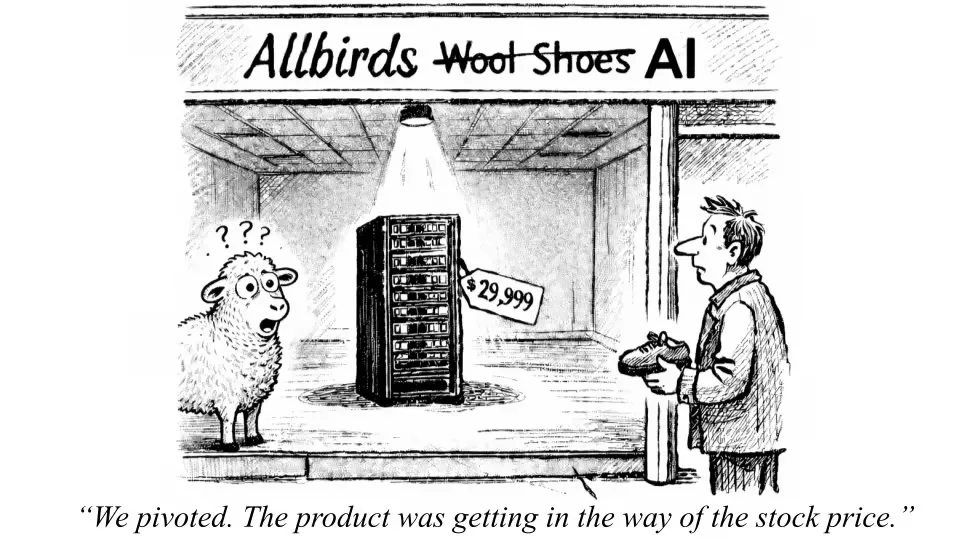
Everyone is trying to figure out how to become “AI native” – the version of themselves that is doing everything the AI way: tools, skills and mindset.
Both at the individual and organization level.
What we’ve learned is that there are two ways to do this: the easy way and the hard way. Each has its pros and cons.
The easy way
Allbirds – the San Francisco maker of merino wool sneakers – was built on Silicon Valley self-mythology: a wool shoe marketed as technology, with a carbon-neutral sneaker sold as a revolution.

It was valued at $4 billion when it IPO’d in 2021. The stock has since shed 99% of its value.
Last month the company sold all of its assets for $39 million.
The corporate shell that is left – without the shoes, wool, or staff who knows what it once was – announced it would rename itself New Bird AI and start building and renting out data center capacity.
The wool is out. The carbon neutrality is out. The sheep, presumably, have been reassigned. In their place: GPUs and the words “artificial intelligence,” repeated across their SEC filings with the frequency of a nervous tic.
The stock surged 714%.

Dave Portnoy, the man who turned day trading into a spectator sport, looked at it and said, “I don’t get it.”
That’s the easy way.
On an individual level, the equivalent is perhaps taking a year off work to learn everything about AI so you can re-enter the marketplace re-energized and “AI native”.
There’s nothing wrong with it. It’s just that the “easy way” is never as easy it might first seem.
Allbirds faces a GPU shortage, protests to data center build outs and competitors who have been doing this for a decade with a hundred times the capital.
The hard way
The hard way is less cinematic. No one’s stock surges 714%. But the changes are more durable.
- Train your people to build. This is the highest-ROI activity no one talks about because it’s boring. We trained our entire staff on AI coding – two hours, one time. Now they’re building their own tools. What used to take someone four to eight hours of manual data work now takes five minutes inside something they built themselves. Later this week, ~20% of our staff will each demo what they’ve made. Some are automating grunt work. Others are running analyses they never could have attempted before. The gap between “I need engineering to build that” and “I built it over lunch” is closing fast. Has your company noticed?
- Audit before you automate. You cannot fix what you haven’t mapped. We’ve walked into organizations where 25% of full-time staff – project managers and other administrators mostly – spend 60% of their time on data entry. Not managing projects. Entering and moving data. The audit is unglamorous work: trace the actual workflow, identify what data you rely on, how much of it is documented, and where a prompt or a deterministic process could replace a human clicking between five different applications. Skip this step, and you’ll automate the wrong things beautifully.
- Use what you already pay for. Every tool in your stack now has an AI layer, but most companies either haven’t turned it on or fully utilized it. For example, Power Automate lets you plug GPT into workflows. Excel has AI plugins that can do in seconds what used to require an analyst and a favor. Start by looking at what’s already sitting in your licensing agreements collecting dust.
- Build for the repetitive. Once your staff have picked up building tools for the low-hanging fruit, start to build purpose-specific applications that plug into wider systems. These are for the workflows that repeat weekly: the literature review, the sales data analysis, the customer complaint reviews. These pull from your existing systems, produce a first draft, and let your people spend their time thinking instead of assembling.
- Wire it all together. This is where it gets ambitious. What we’re building at PreScouter is an intelligence layer that sits above our project management and operational systems – a single interface that knows where everything stands, handles the administrative overhead, and frees our team to do the work that is actually valuable: working with clients, developing novel approaches, and making judgment calls no model can make yet.
That’s the hard way.
No rebrand. No surge. No clean break from the past.
Just the steady transformation into the next version of yourself…